

Finding Home in Being Lost
By Sorah Guthrie ‘25, Taigu Fellow 2025-2027
Around the start of the semester, I went on a walk at night and under the fluorescent glow of a lamppost. Like a beacon, I saw a set of oil paints, a wooden palette and easel, and a canvas with a half finished painting. I wondered who was painting there, who had sat on the folding stool and how could I follow the breadcrumbs to the creative community of Taigu? I left a note in pencil on a napkin that read, “My name is Sorah, I like to paint. I live in the red houses.” The next day it rained, so my note must have become soggy pulp and I don’t think my vague message would have prompted the nearby artists to contact me anyways. But a couple days later, I went back to investigate and found more remnants of painters. As I walked through the old campus, I saw easels and oil paintings scattered around the traditional archways. I made my way to the small track and saw a student painting in the shade. I mustered up my courage, armed with my Google Translate and approached him. In Chinese I said, Hello, I’m a foreign teacher. I like to paint! He immediately offered me his paint brush and said, Ok! Then paint! gesturing to his painting. I was taken aback at how inviting he was, how willing he was to let a complete stranger mark his work. I refused saying no, no, I couldn’t possibly touch your artwork! He then instructed me to wait there and after a few minutes he returned with a canvas for me. Overwhelmed by his sudden and unearned generosity, I told him thank you, but I couldn’t accept. I learned he was in a painting class, he insisted on calling his teacher and asked if I could meet her. I am often overwhelmed by the kindness extended to me in Taigu from strangers who treat me like old friends, their daughter, or sister opening themselves to me with no hesitation. I have not yet figured out how I can possibly return their compassion.
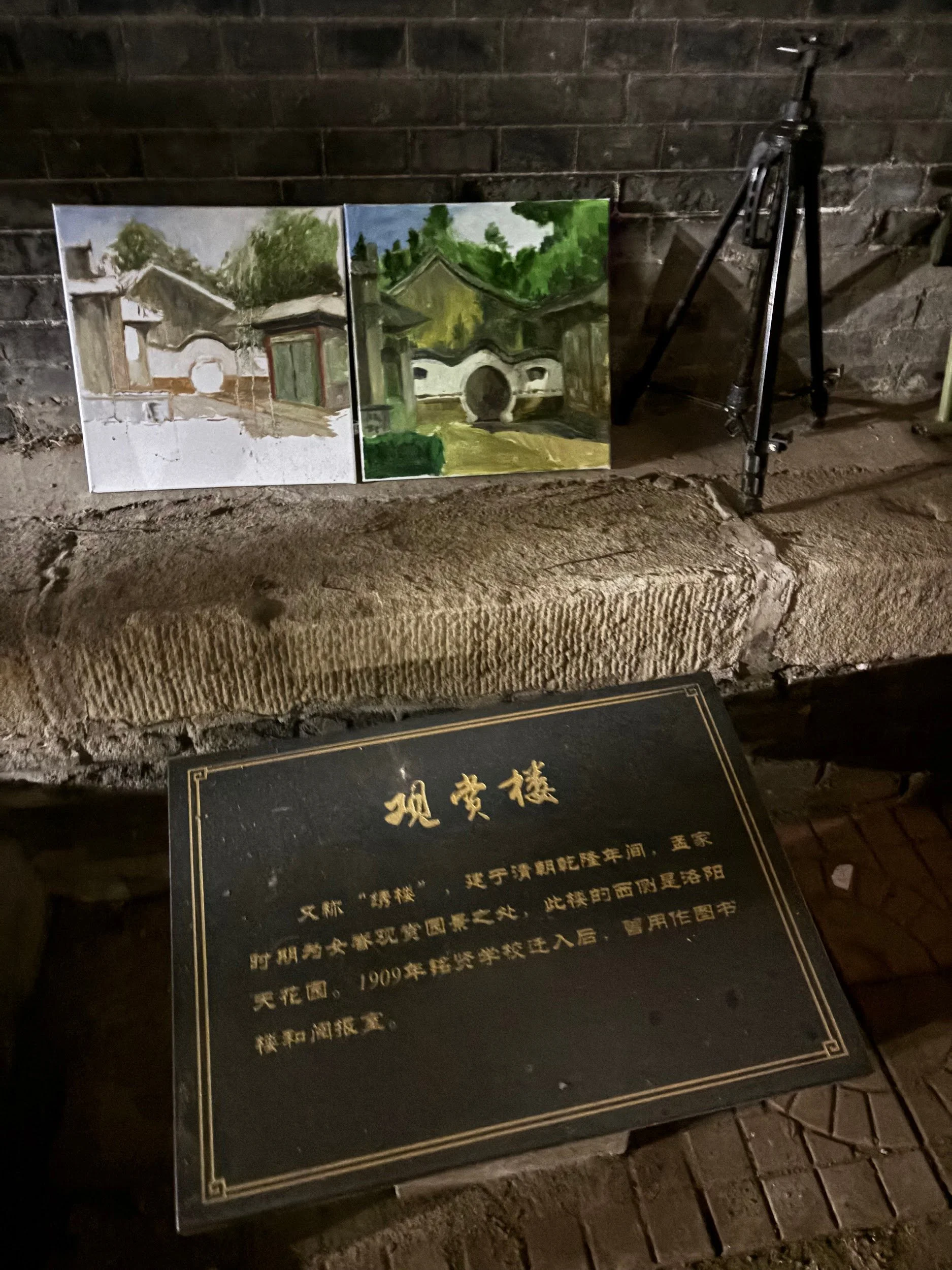
I followed him to the experimental building, where most of the laboratories are, with Moomoo and Honey in tow (two dogs we’ve befriended). We wandered down multiple dimly lit hallways passing students in white lab coats, rooms filled with beakers and vials, and offices—the people inside turning their heads as Moomoo’s paws click-clacked on the tiles. We took the elevator up to the fourth floor and walked through a mezzanine overlooking an indoor badminton court in the middle of the laboratory building—a combination which feels to me quintessentially Chinese. He seemed to be lost, leading me in circles around the maze of indistinguishable corridors. Walking past identical door after identical door, he finally stopped in front of 608, pausing for a moment before knocking. The door opened slowly, a woman introduced to me as Wang Laoshi emerged. She beckoned us in and I stepped into a room filled with color; the walls were lined with watercolor cherry blossoms and peonies while ceiling high canvases leaned stacked against each other. In the center of the room was a giant easel, with a 6ft tall painting of Chinese drummers balancing atop it. A large glass palate had swatches of purples, reds, and browns where underneath lay a treasure trove of oil paints. The smell of linseed oil and gamsol flooded my nostrils as I was instantly transported to a feeling of familiarity. Who would have thought behind this unassuming, nondescript door lies a complete oil painting studio overlooking the badminton courts in a laboratory building? The air was hazy with cigarette smoke, plumes falling from the mouth of an older man, sitting by the window, working on an expressionist sunflower painting, the brush hanging from his fingertips as he gazed at me in confusion. I learned he was another painting teacher. Wang Laoshi poured us tea as I stumbled through my explanation of why I was in China, how I had found her studio, who I am, finally coming to the roundabout conclusion that I just wanted to paint. Relying on my 2 month knowledge of Mandarin, my new friend, and translation apps, we talked about finding other artists and she assured me that whenever I wanted to paint, I could come here, to her studio.
I joined her painting class and sat in the old campus with other students, painting still lifes of old campus buildings, just happy to be in the vicinity of other artists, even if we only exchanged fragmented sentences and smiles. Last year, I almost only painted pictures of aerial topographic maps of North Korea. Not only painting, but also map-making is a practice I continue to return to, always interested in how we designate space, borders, and orient ourselves in an everchanging geographical, political, and imaginatory landscape.
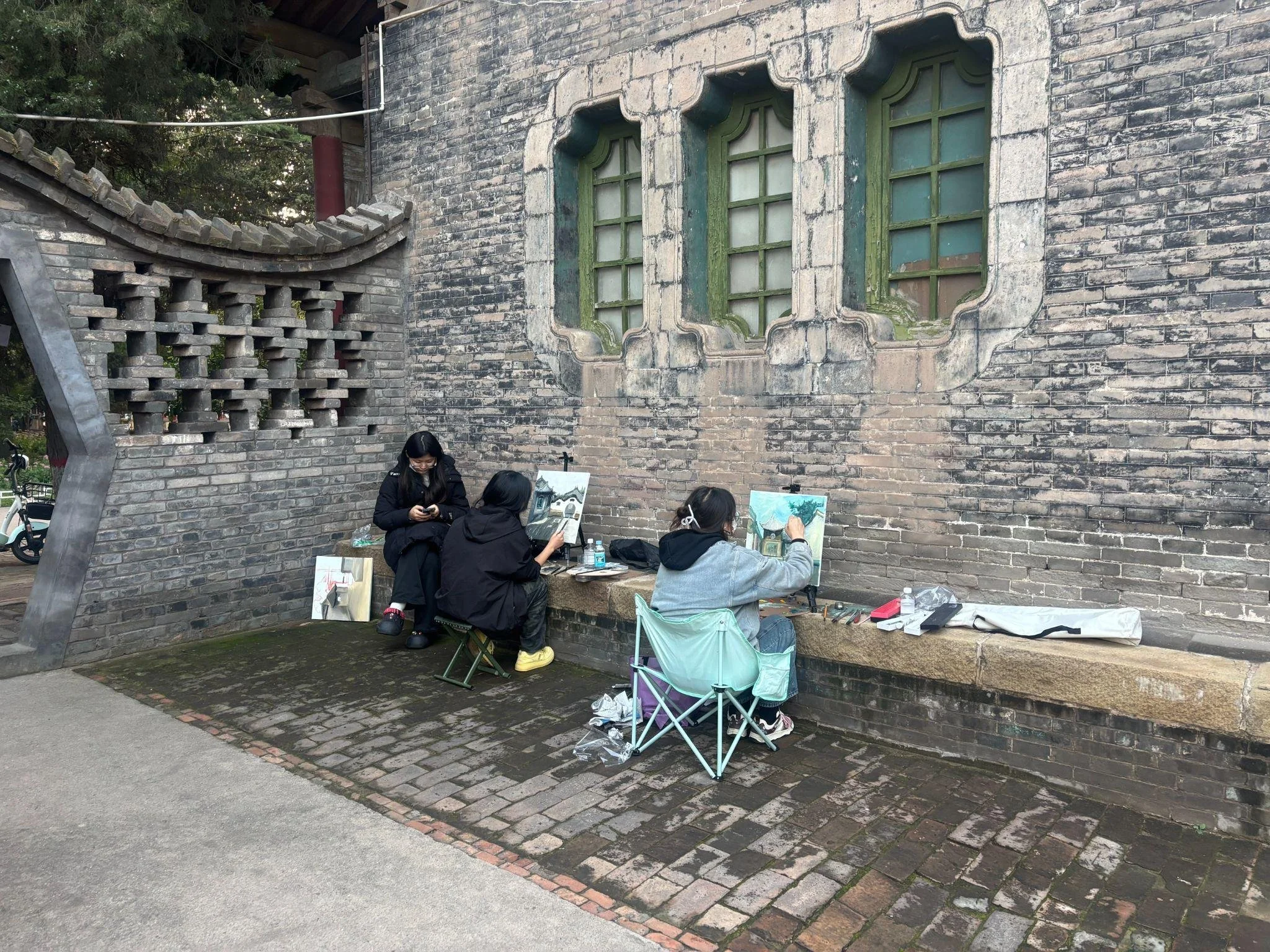
Painting class in old campus
Before I came to China, I was terrified of the unknown, anxious to figure out every detail of my future day to day life. There is no Google Maps street view for Taigu, no coordinates for me to acclimate myself with, I felt map-less. Rebecca Solnit writes about the art of being lost, “collaborating with chance” and finding yourself while traversing unknown territory. To purposefully be lost is to open yourself to discovery, invite the unfamiliar with open arms and arrive at the feeling of “being at home with being lost.” To accept the loss of a map is to welcome a state of being lost as an opportunity to create my own atlas. In my first few months in Taigu, I spent much of my time exploring the mountains by electric moped, taking winding roads through small villages and corn fields. I felt comforted by the expansive countryside, held by the scenery flying past me and buzzing with the excitement of experiencing everything that was new. With each turn I made, my mental map of Taigu slowly etched itself over the emotional topography of my inner landscape. Mapmaking is not just a geographic process, but also a way to orient the soul; “Expand(ing) the conception of a map as a flat reflection of geography and reclaim it, instead, as a living, breathing, dimensional expression of the human spirit”(Popova). In being lost, you become a cartographer tracing the contours of the earth, filling in gaps with your memory and attempting to certify your place in relation to the country and culture you exist in.
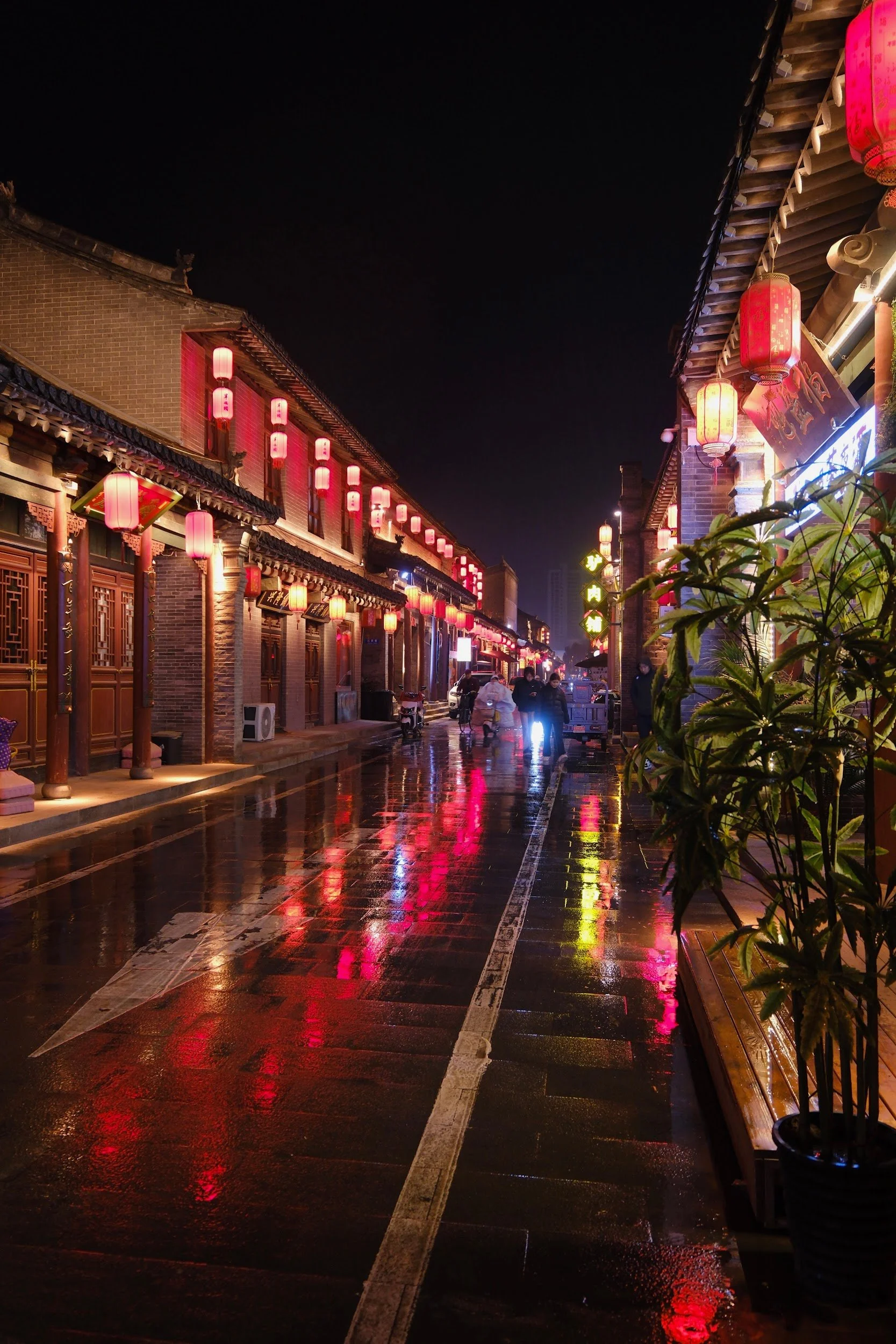
Old town in the rain
One night, while walking around campus with Moomoo and Honey (it’s their world and I’m just living in it as their sidekick), I heard the sound of a rock band, the beat streaming out of an open third-floor window in the Animal Science building. I wandered around the building following the music until I stumbled across three girls in a room I learned belonged to the student union. They invited me in, and playfully covered Moomoo’s ears as their friend rocked out on the drum kit. When you’re lost, you find awesome things.
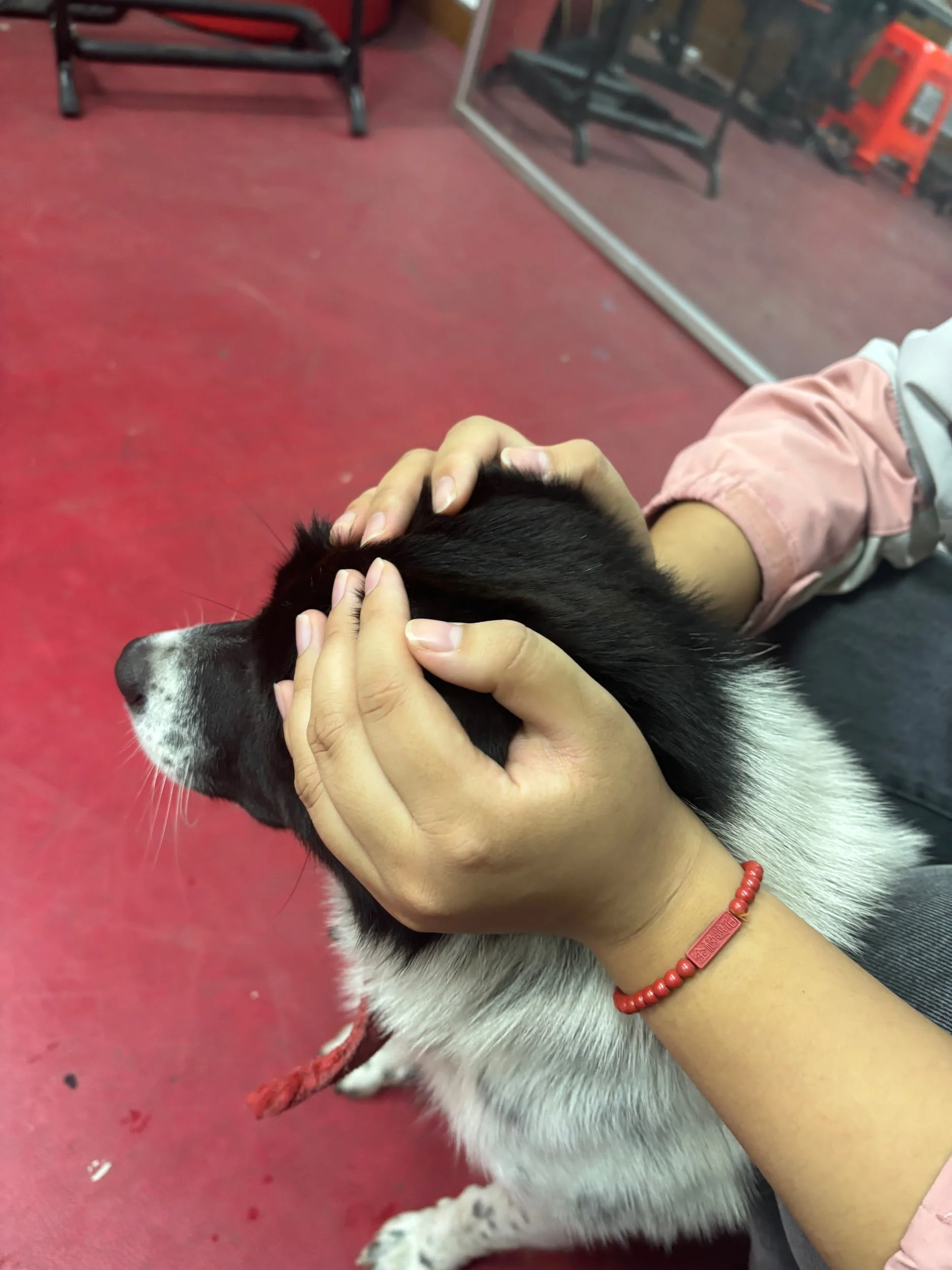
A student covering Moomoo’s ears as her friend played drums
Now, I don’t feel so lost. My map has become detailed, peppered with places I now hold close to my heart; the xiaolongbao place we go to at least three times a week, the various mahjong parlors our Chinese friends have shown us, the greenhouse Haley brought me to in my first week, the spot under the library stairs where the dogs hang out, and so many more. I am amazed at how quickly the unknown becomes home. Many of these places are inherited, passed down from generations of Taigu fellows, adding to the collective Shansi map that exists in memory, changing from fellow to fellow, each with our own landmarks and pathways. Through terrain I am connected to a large legacy of Oberlin alumni who lived in the very room I do, looked out at the same green grove of trees, walked the same stone paths, and perhaps also admired the birds perched on the tiles of our little red house in the early morning. And I wonder if the grass and the roses and the trees remember us too, how they have watched years of Obies get lost and find our place and leave as changed people.
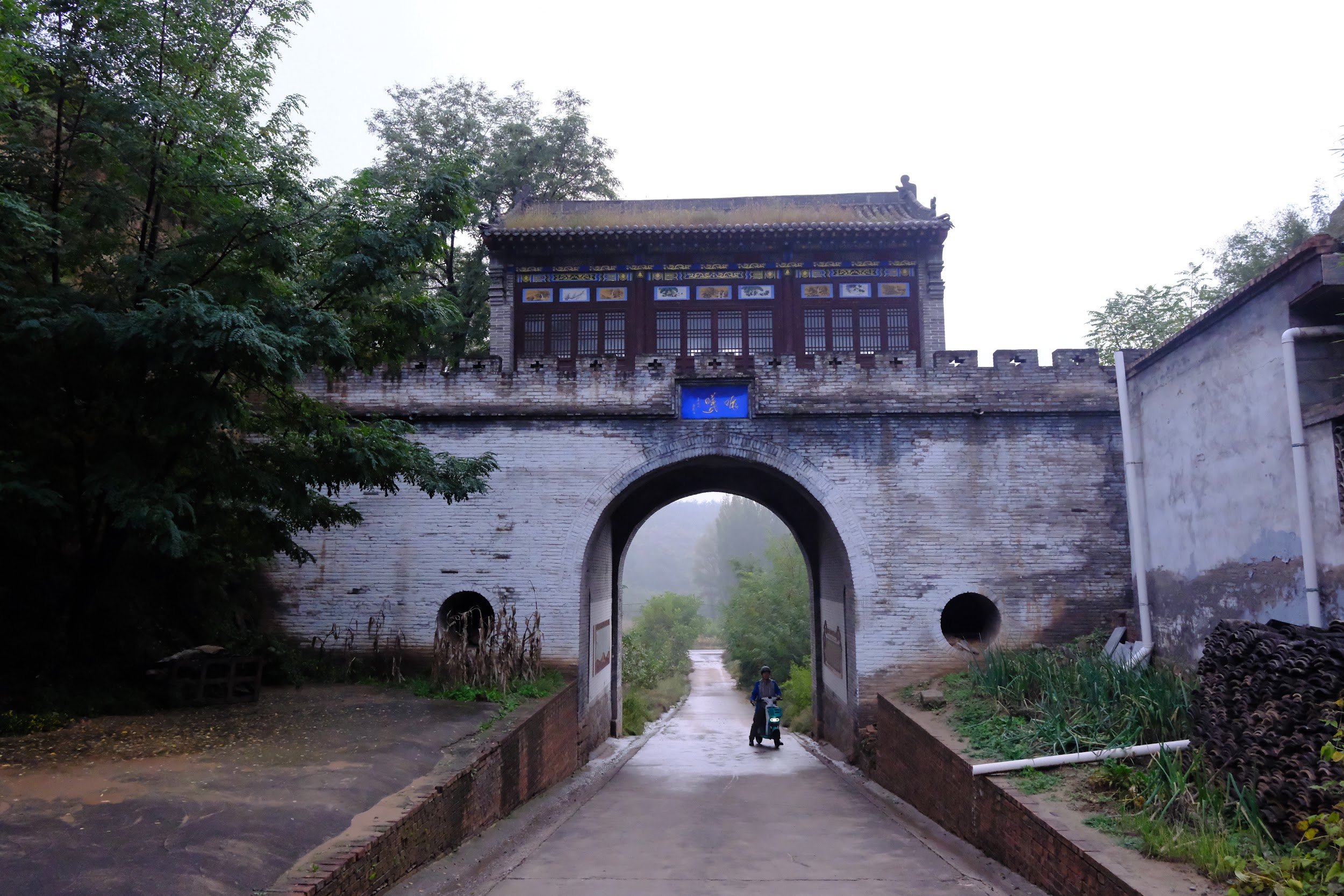
Yuji and I found this gate while exploring the mountains
Works Cited:
Popova, Maria. “Where You Are: Cartography as Wayfinding for the Soul.” The Marginalian, Where You Are: Cartography as Wayfinding for the Soul.
Solnit, Rebecca. A Field Guide to Getting Lost. Penguin Publishing Group, 2006.