

Aceh Story Lab
By Yana Levy ‘24, Syiah Kuala University Fellow 2024-2026
It was presentation day in one of my speaking classes, and I was thrilled because that meant it was my day to sit back and relax while my students did all the talking. But with each group that presented, I felt that excitement turn to dread. They stood stiffly, with phones inches away from their noses, robotically reciting and mispronouncing sentences that are way above their English levels. Each group had clearly typed the same prompt into AI, and the result was 10 presentations which were all essentially the same. Each one felt like proof of my failure as a teacher. Stopping the class would humiliate them, and myself, so I sat for those two grueling hours, and reflected.
I'll confess that prior to getting the Shansi Fellowship, I did not have a background in language pedagogy whatsoever. And despite the training and resources that Shansi has provided, nothing could truly prepare me for all the nuances of leading a classroom in Banda Aceh. As such, I've relied on my training in facilitating interfaith dialogue to inform how I conduct a classroom. In a dialogue space, the goal is to empower people to speak their minds on tricky topics and build relationships across differences. So although I may be completely useless when my students ask about grammar, my non-traditional approach to education gets the students laughing, having fun, and speaking confidently. I joke that my class is run more like a game-show than a lecture, but I think the real magic happens when I can help students get out of their own way.
I don't believe my students use AI to complete assignments because they are lazy. Instead, I see this behavior as reflective of an educational system that emphasizes polished results, over the intrinsic value of learning itself. I feel it in my classroom, with my 40 students sitting in neat rows facing me, too nervous to speak because they believe mistakes are failures rather than a natural part of the learning process. After my first semester teaching I decided I wanted to take matters into my own hands, create some new program where I could experiment with relational kinds of learning, a pedagogical counterpoint to my FKIP classes. But despite my grand ideological aspirations, practically, I had no idea what this program would look like.
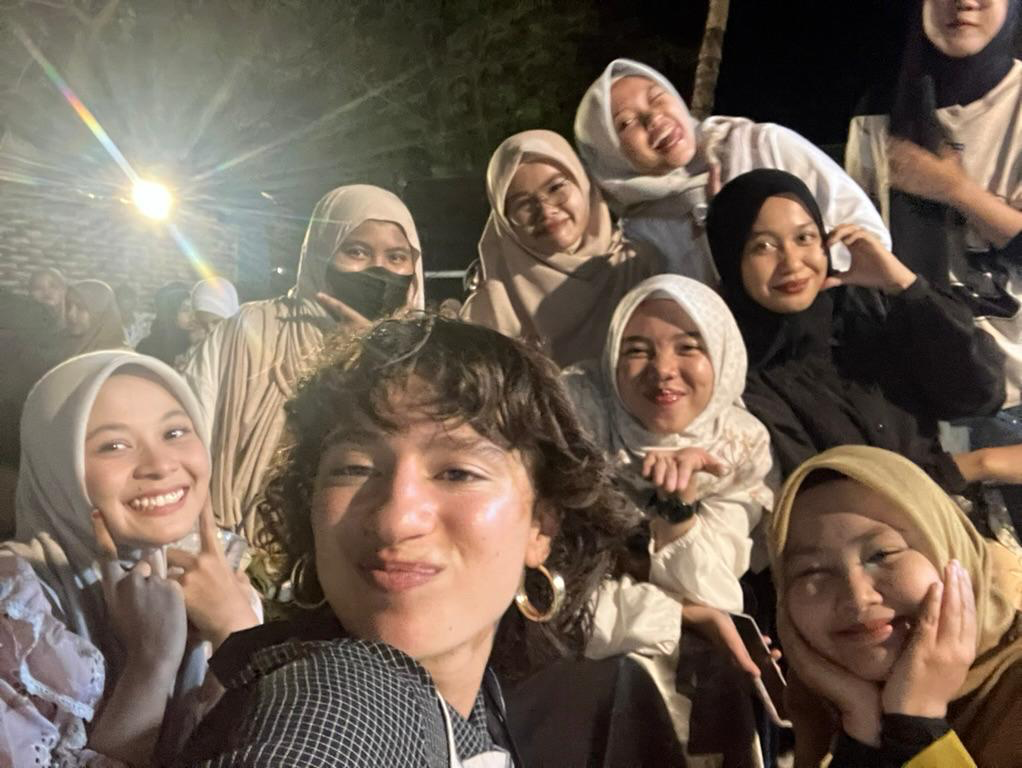
The crew from the first story lab
The idea finally came to me on a rainy day. The kind of day where Noah's-ark-like down-pours cause plans and classes to be cancelled. I was puttering about my room, doing important tasks like re-organizing my collection of paper scraps and testing all my pens to find the dead ones, while a podcast played in my headphones. My go-to podcast on gloomy days like this is always The Moth Radio Hour, a collection of recordings from shows around the world where normal people take the stage to tell a true story from their lives in front of a live audience. I find there is something deeply comforting in hearing people make sense of their lives like that, their disparate experiences made whole through the power of a well told story. And it dawned on me, as I listened to their small voices competing against the hammering of rain outside, the enormous amount of courage it takes for someone to share that much of themselves in front of complete strangers. I knew that's exactly what I wanted to give to my students.
I whipped open my laptop, opened a new document, and typed out the words ‘Aceh Story Lab’. The idea was to select 6-10 students to participate in a four-week-long workshop series, each week focusing on a different element of storytelling, then hosting a final performance where they would perform their stories publicly. Approval from my faculty came quickly, my senior fellow Ari agreed to help out, and things were set in motion!
Applications were released, and I spent the next three weeks obsessively refreshing the Google Form. Though many applications were just repeats of an AI generated response, there were a few that blew me away. Wrote one applicant, “Throughout the entire ordeal that was my college life, I'd found very little time to do anything else besides my major loads and my part time jobs, and by my last year of classes I regret everything. I long to attend these meetings where I can probably dig a glimpse of jewels that are my skills and capabilities, to enjoy myself experiencing something beyond my comfort zone, to hear and be heard.” Another wrote, “I usually keep my thoughts and feelings in writing, but this program feels like the right place to try sharing them out loud. I want to learn how to speak with more confidence and connect with others in a way that’s honest and meaningful.” I had promised to limit the class to 6-10 students, but ended up selecting 11.
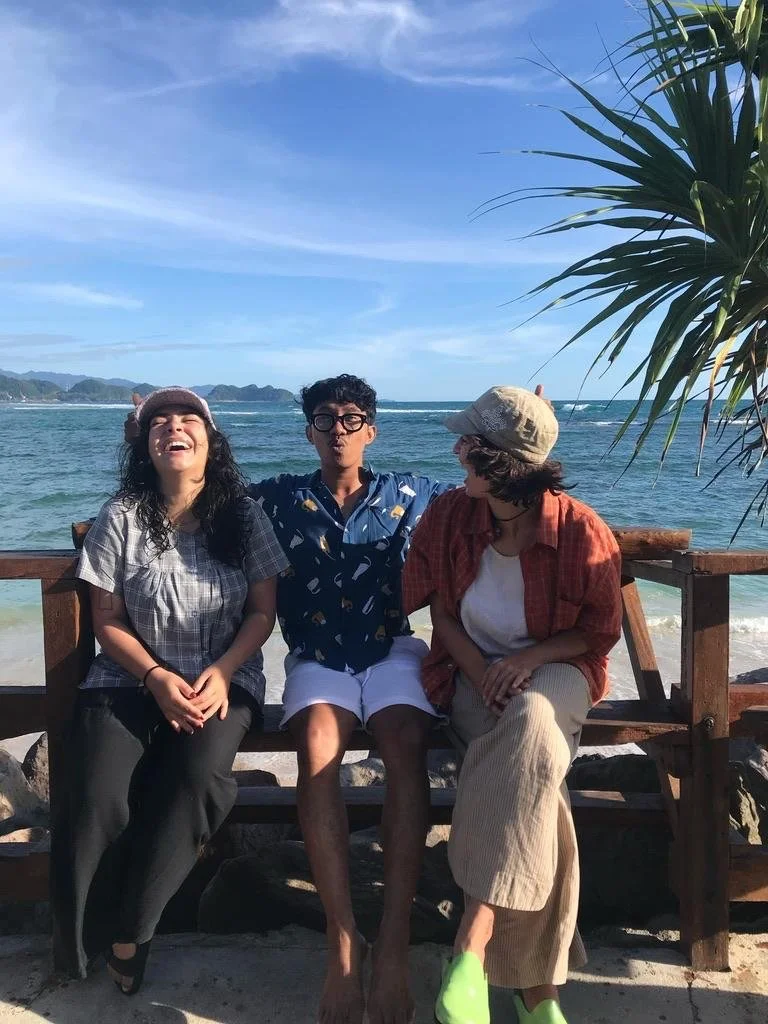
Ari and Yana with Azmi, a local collaborator
From my observations of the culture of Universitas Syiah Kuala (USK), students are defined firstly by their majors, and it's rare that people socialize outside of their departments. Furthermore, extracurriculars are often career oriented, offering the external incentive of a certificate (important for applying for jobs later) rather than simply a chance to be a part of a community or try something new. All to say, what we were doing was completely out of the box. So that first workshop, when the 11 selected students, graduate and undergraduate, from all different academic backgrounds filtered in, squishing around the long table we had set up in the middle of the room, nobody seemed to know how to interact with each other… or us. By the time we were halfway through I was starting to feel exhausted trying to pull responses out of their nervous silence, and put on a video to give myself a break. I chose a story from a Moth live event, Katiana Ciceron telling the story of learning Haitian Creole so that she could communicate with her mother who didn't speak any English. It ended, I cautiously prompted any responses, and before we could fall back into that awkward silence, one student raised a hand. With a small voice that grew bigger as she continued, she shared a childhood experience about being mocked by classmates for speaking Achenese over Indonesian, who called it bahasa kampung or ‘village talk.’ It felt like the whole room exhaled, and others began to share similar experiences of finding their place within Aceh’s messy tapestry of multilingualism and overlapping cultures.
After the ice was broken things flowed more naturally and the workshop quickly became my favorite part of the week. With each Wednesday of those four weeks I saw more friendships developing within the cohort. Instead of filtering into the classroom one by one, people showed up in clusters, and once class was over some would leave together to go get dinner and hang out. After a while they started inviting me and Ari too.
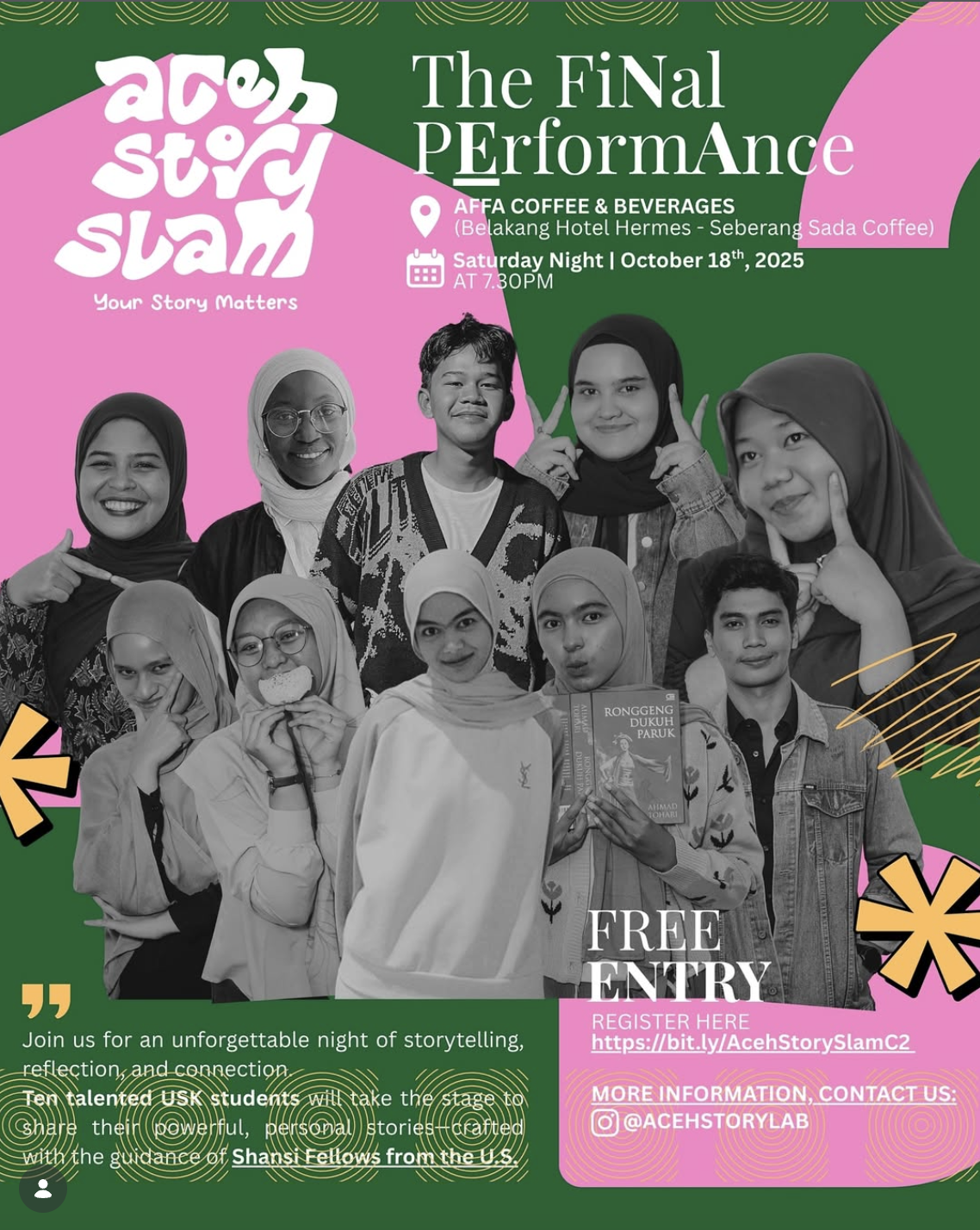
Poster for Story Lab event
Aceh is a deeply complicated place, full of irreconcilable contradictions that I often struggle to make sense of. But in that space, listening to my students speak openly about their lives, I felt my perspective deepen and expand. It's true that some things they shared were way outside my frame of reference. For example, a common experience among many of our students was having to interact with the ghosts (both friendly and unfriendly) who apparently haunt all boarding schools across Aceh. Another student described how, in a religion class (mandatory as part of the university's core curriculum), he was assigned to ‘play corpse’ which entailed pretending to be dead while his peers bathed his half naked body, wrapped it in linen then literally buried him in the ground so they could practice death rites. However, as our conversations veered into territory I had previously believed unbroachable in Aceh: gender identity, patriarchy, mental health, ect. … common ground opened up that I had not known existed. They described the struggle to find a sense of belonging, feeling social pressure to look and act a certain way, the process of learning to trust your instincts, all things that were deeply familiar to me. As we got further into the workshops, I felt like I was being given different eyes through which I could see Aceh more clearly.
Finally, after weeks of discussions, drafts, dress rehearsals and many dozens of JCO doughnuts, the day of the final story slam had come. I arrived at the venue multiple hours early, buzzing from multiple cups of coffee, organizing and re-organizing chairs, sweating, all while wondering out loud to everyone around me why the audience was not showing up. In retrospect, I'm certain that I was stressing everybody out, but this was my baby, and I wanted it all to be perfect. To my great relief, in typical Achenese fashion, the audience finally started filtering in 15 minutes after the event was scheduled to start. Soon we had over 50 people who filled the patio of the cafe, ready to watch our storytellers tell their tales.
We began the performance only an hour late, and with each student who took the stage, my anxiety melted into glowing pride. One student talked about growing up with the stigma of being left-handed. Another spoke about how their dream red-shaggy-k-pop haircut was forbidden by their dad who accused them of wanting to ‘look like white people.’ Another shared about how her parents covert plan to bring her to the traditional healer so he may perform a ritual to heal her depression, led her to taking her mental health into her own hands. My worst fear had been having an inattentive audience, people on their phones, chattering or god forbid laughing over the performers. But they were gripped, laughing at every comedic pause, gasping during the dramatic emotional moments. With each student who took the stage, pausing for a moment — just as we had taught them — to take a deep grounding breath, I saw that courage I had hoped to instill, embodied.
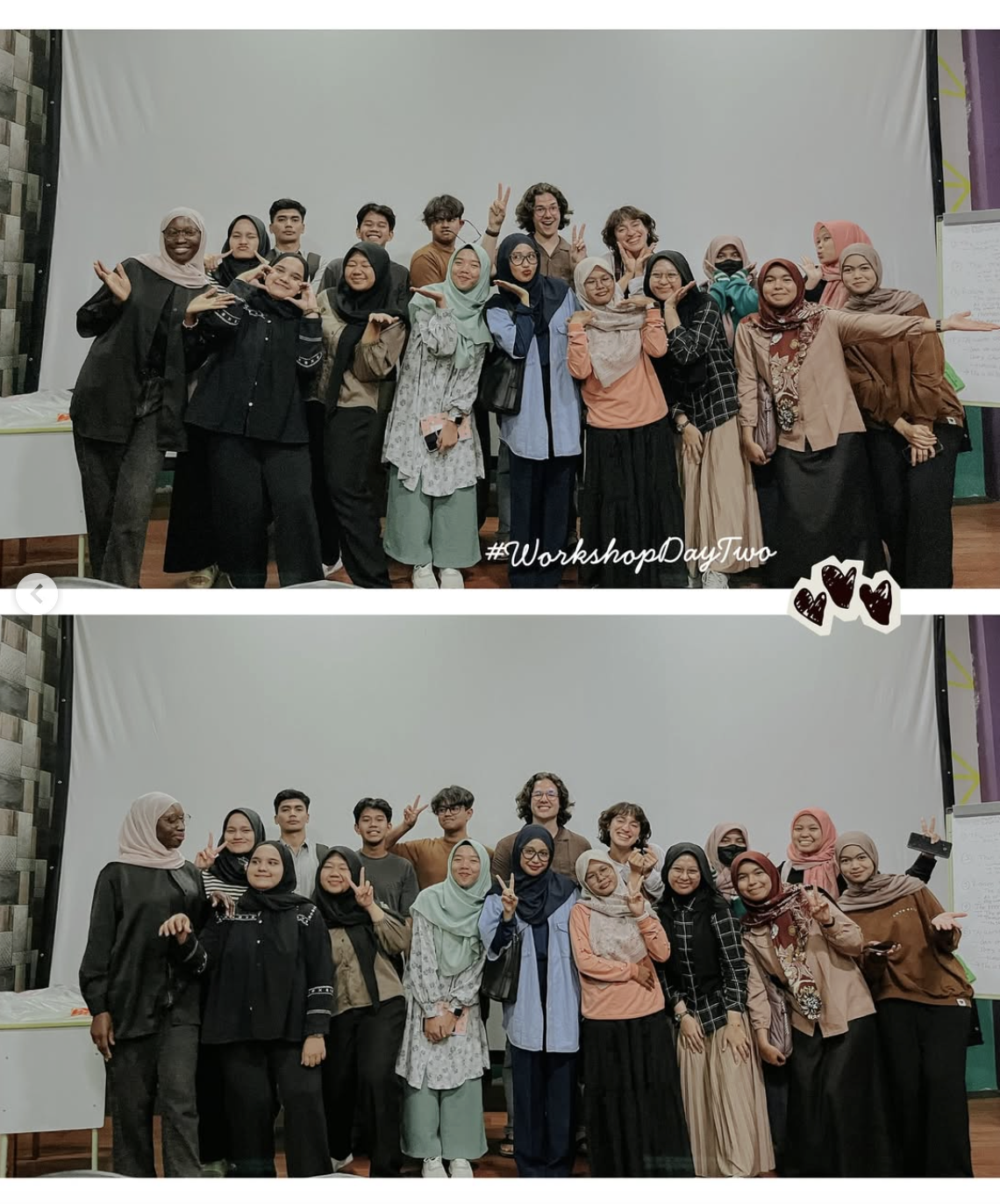
Group pictures from a workshop
When it came time to perform, even those students who worried me the most, whose drafts were turned in late (or not at all) surprised me with how much presence they brought to the stage. There was one student in particular, who surprised me the most. The earlier drafts of her story were about an acquaintance who had passed away suddenly. In my comments I gently pried for the emotional meat, but was still not sure why this was the topic she had chosen. In dress rehearsal, she recited the story rather stiffly, with an uncanny smile that confused the seriousness of the content. I wondered how to support her, but recognized that her process was out of my hands. The day of the story slam, when she took the stage her tone was completely different. Her voice, shaky at first, steadied as she plunged deeper into the story. This was not some casual acquaintance but a cherished childhood friend, who she had lost touch with as they grew into adolescence, and, one day, learned had suddenly passed away. The shock and weight of this news, the regret of not having kept in touch better, those feelings were so raw that she broke down crying onstage. But the audience, who I had been so fearful of tuning out, cried with her, hanging on to her every word. For a moment, it felt like we were all grieving together. She stepped down off the stage and into a bear hug from her peers.
In a place like Aceh, with so many layers of collective trauma, what does community healing look like? As an outsider, I know it's not my question to answer. But that night, I got a glimpse into the transformative power of speaking vulnerably and being truly heard.
The day following the performance, the whole crew gathered at Sophie's Sunset Library, a cozy beachside nook known for attracting the more artsy subversive crowd, frequented by many a past Shansi Fellow. From morning to evening we were there, sharing snacks, playing Uno, chatting, and making art. The ocean from Sophie’s looks wide and flat like a pancake, spreading out against a background of soft green mountains. That day there were no waves, just a giant round bathtub filled with calm turquoise water. I was the first to swim, and was soon joined by Ari who had forgotten swim clothes and dove in wearing a plaid shirt and jeans. One by one our students followed, until our whole class was chest deep in the Indian Ocean. For some, this was their first time being fully in the ocean. But the water was calm and embracing. We all held hands in a circle, steadying one another against the gentle swaying of the current.
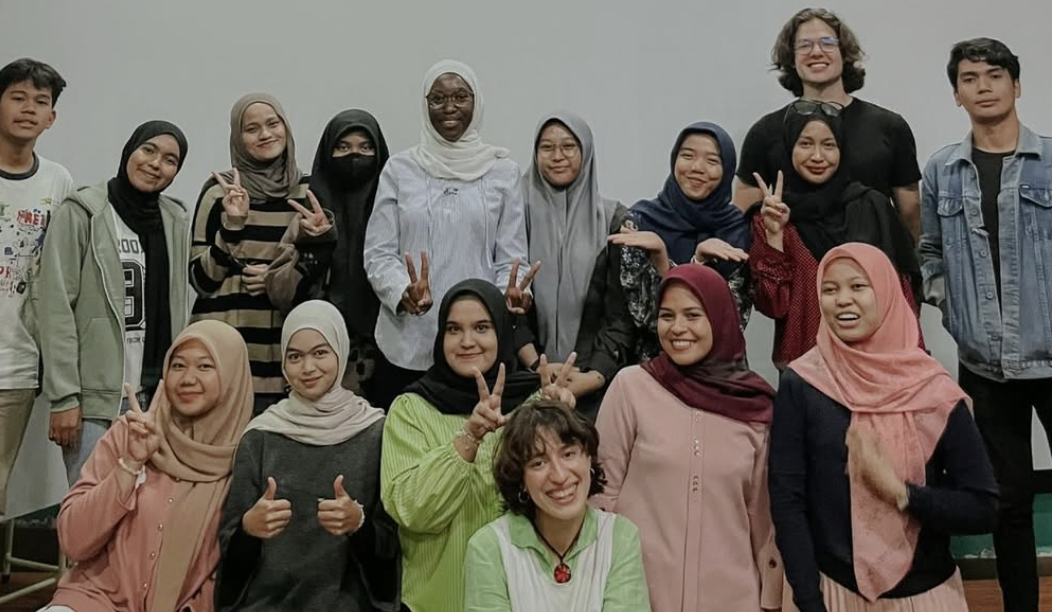
Aceh Story Lab Cycle 2 participants
Once dry and back on the beach, we gathered to share reflections from the program. Some gave feedback on the content, the lessons, and the final performance, but one idea rose to the surface as it was re-articulated by each student. The biggest takeaway from these last four weeks was the community we had built together, where they could be fully themselves, a gem that is hard to find anywhere, not just in Aceh. It came my turn to share. I got choked up talking about how starved I had been for community since getting to Aceh, how much it meant that they trusted me to lead them into territory that was new to all of us, and embraced me in such a genuine way. I had created this space for them, but as it turns out I had needed it just as much. It was my turn to be bear hugged.
In the year since that day on the beach, the people from that first story workshop have become some of my go-to friends. I see them at least twice a week (often more) and they are the ones I text if I need to know where to find the best fried duck, have a random Indonesian slang I need translated, or a buddy to take me to the doctor. And the program has continued.We held a second workshop this fall, and in the spring we will hold another — the last before my fellowship is over. But the story slam won't end when I’m gone. The students from the first cycle have taken a lead in planning events, leading workshops, and mentoring the new students. Seeing the friendships that have come out of this program, as well as the enthusiasm they have towards ensuring it continues, has clarified leadership for me: it’s not just about implementing one's own vision, but about creating spaces where others can connect, be heard, and lead themselves.