Since 1908
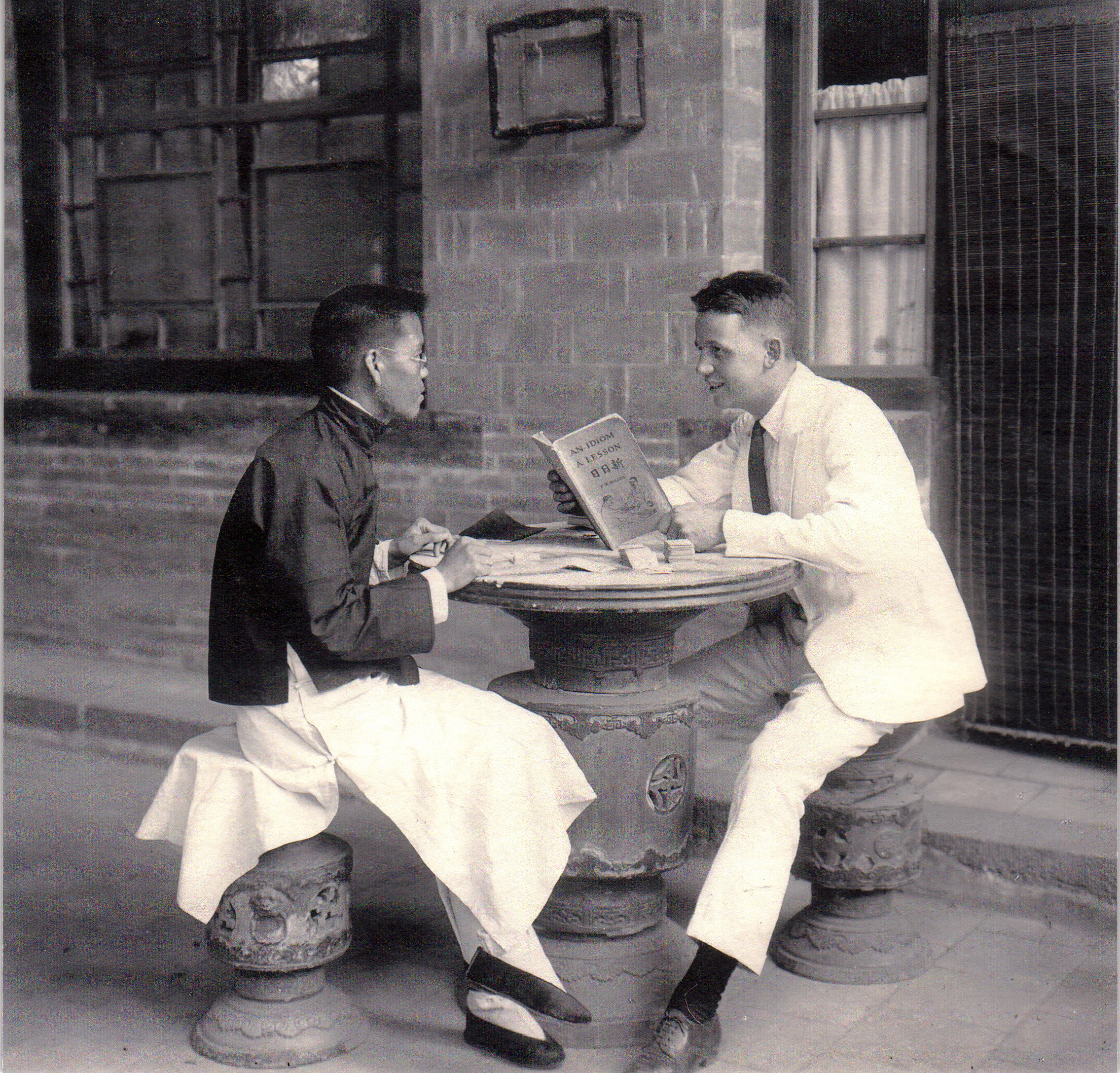
Image: Shansi Rep Raymond Moyer (1921-23) studying Chinese with his teacher in Taigu, China.
A brief history of Oberlin Shansi
In the fall of 1907, Oberlin College graduate H. H. Kung (’06) established the Ming Hsien School (for boys) and Beilu School (for girls) in Taigu in the Shanxi Province China. Kung was inspired by his experiences at Oberlin College, and his earlier time as a student at the school established by Oberlin Seminary graduates serving as missionaries in Shanxi.
The Oberlin Shansi Memorial Association (Oberlin Shansi) was founded in January 1908 with the purpose of establishing and supporting Kung’s educational efforts in Shanxi. Initially, cash and equipment (such as lab materials) were provided. Later, two-way exchanges became central to the relationship when, in 1918, Oberlin Shansi began to sponsor Oberlin students and graduates to travel to Taigu to collaborate with the schools established by Kung. These exchanges launched the Shansi Rep Program, now known as the Shansi Fellowship. Over the following decades, Shansi Reps introduced new teaching ideas, agricultural research approaches and technologies, and continued to work with these communities even after they were evacuated westward during China’s Civil War.
In the spirit of mutual exchange that is central to the work of Oberlin Shansi, the Visiting Scholars program was introduced in 1927. Ming Hsien School faculty and staff traveled to Oberlin, Ohio to study pedagogical and administrative approaches, share Chinese culture and knowledge, and bring home new educational methods and principles. This laid the foundation for a century of intercultural exchange involving educators, intellectuals, artists and practitioners, and continues today with Oberlin Shansi hosting visitors from China, India, Indonesia, and Japan.
Following regime change in China in 1949, and the outbreak of the Korean War in 1951, Oberlin Shansi’s China connection was effectively severed, with no expectation that Reps might ever be able to return. Adapting to changing circumstances, Shansi entered new partnerships in India, Japan, and Taiwan, continuing Oberlin and Shansi’s legacy of engagement in Asia. Simultaneously, Oberlin Shansi began its own internal evolution as well. While its core mission was always centered around education, Shansi began to more formally secularize, and by 1972 any mention of “Christian education” was removed from the organization’s Regulations.
From the 1950s through the 1970s, Shansi consolidated its partnerships, prioritizing regular engagements with partners in India and Japan. At this same time, however, Shansi also entered experimental program partnerships in Korea, the Philippines, Indonesia, Thailand, Sri Lanka, Nepal and Afghanistan. In 1979, after the normalization of US-China relations, an invitation to renew ties in China led to the resumption of Shansi’s work in Taigu in 1980. Four Shansi Fellows arrived in Shanxi that summer after a nearly three-decade hiatus. The two partners found their way back home.
Today, Shansi partners include universities, non-governmental organizations, and even one international agency in China, India, Indonesia and Japan. In recent years, Shansi has also heavily invested in programs outside of its post-graduate fellowships. From programs such as the In-Asia and AAPI experience Grants, to its Visiting Artists and Practitioners program, Distinguished Lecture Series and active engagement with the Oberlin community at-large, Shansi continues to be an impactful organization in Asia and at home.. Nearly 110 years since its first Reps departed for Taigu, Shansi remains deeply committed to its mission of promoting cross-cultural exchange, meaningful collaboration, and joining worlds.
THE SHANSI ARCHIVE PROJECT
A large part of Shansi’s history has been documented over the years with pictures, letters and other material culture by Shansi Representatives (“Reps”), Fellows, partners, and staff members.
A comprehensive sample of Shansi’s material archives were digitized by a team that included Ann Sherif, Professor of Japanese; Bonnie Cheng, Associate Professor of Art History and East Asian Studies; Carl Jacobson, Oberlin Shansi Memorial Association Executive Director from 1981-2012; Ken Grossi, College Archivist; Anne Salsich, Associate Archivist; and student project assistants Alyson Halpert, Class of 2013, and Amanda Tobin, Class of 2011.
With help from a Andrew W. Mellon Foundation grant, Jacobson and Grossi elucidated and contextualized the significant history of the Oberlin Shansi organization through their co-written introduction “Oberlin in Asia: A digital collection documenting the sharing of the ideals of learning and labor.”
The online collection highlights the wealth of Shansi records stored in the Oberlin College Archives. Such items as photos from the early 20th century and full issues of the former Shansi newsletter Dragon Tracks, published from 1938-1946, can be accessed, read, and explored. To visit this website, please click here.
As a result of this project, a portion of Shansi’s materials has become accessible to people all over the world. In addition to Oberlin professors integrating these materials into their classes, scholars have discovered the website and sometimes find the information so comprehensive that they travel in person to the Oberlin College Archives, which houses many Shansi artifacts in several different collections. Click here to browse the collection. To see a timeline that sketches out the story of Oberlin Shansi, click here.