

A Conversation with Marshall Scholarship Winner, Leo Hidy '23
We are beyond excited to have the opportunity to catch up with Leo Hidy! Leo served as the Shansi Fellow to J.F. Oberlin University in Machida as part of the 2023 Fellowship Cohort. A Comparative American Studies Major with a minor in Economics, Leo was a New York City Urban Fellow after finishing his Shansi Fellowship. Now, his career continues to expand, having been named a recipient of the 2026 Marshall Scholarship, through which he will be pursuing higher education and conducting research in the UK.
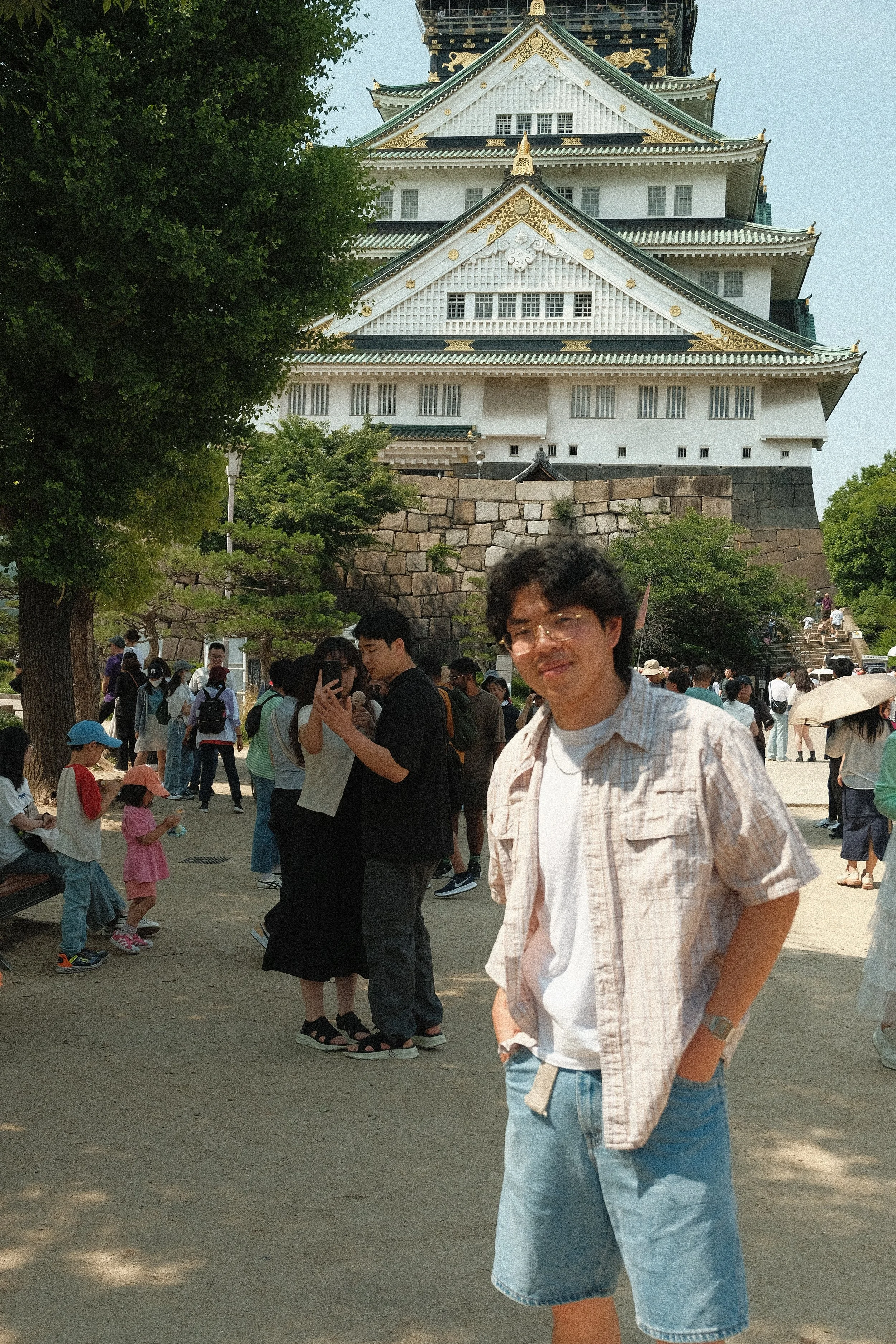
Leo in front of Osaka Castle
So, first and foremost, can you tell us a little about what you'll be doing on your Marshall Scholarship?
The Marshall Scholarship will allow me to pursue two master's degrees in the UK, both focused on urban policy and governance. I grew up in a multiracial household in San Francisco, and my research interests stemmed from my desire to understand the diverse experiences that my family members had with the city. My time at Oberlin helped me clarify this interest into an overarching question that has guided my academic and professional work — How do institutions — dormitories, schools, towns, cities, and states — decide which identities belong and which do not? As a Marshall Scholar, I will specifically dive into the spatial and economic pressures that municipalities place on ethnic enclaves and immigrant neighborhoods. I hope to learn how physical design, government policies, and cultural communities intersect to shape urban spaces. I am super excited to study in the UK because of its deep history of immigrant entrepreneurship and evolving approaches to high street revitalization. Upon the conclusion of my scholarship, I hope to develop practical frameworks that cities can use to support vibrant and diverse urban spaces.

Leo dresses as a bike form micromobility-themed work day with the city government of NY
How long has your plan to apply for the Marshall Scholarship been in the works? Walk us through your journey.
To be honest, I did not really consider the Marshall Scholarship until the spring before applications were due! In typical Obie fashion, my personal, academic, and professional journey has been guided less by strategic planning and more by random interests that snowball into long-term passions, haha.
At Oberlin, I was lucky enough to serve as an RA for Asia House, a co-chair for the student government finance committee, and a PRSM trainer for the Office of Institutional Equity (I also had a brief stint as a Barefoot Dialogue facilitator). At the time, I took these jobs because my friends were involved or because I thought they sounded fun, but I quickly fell in love with each role's commitment to public service.
This interest encouraged me to intern for the San Francisco City Planning Commission, where I saw firsthand how planning policy can support or displace cultural neighborhoods. When I moved to Japan for my Shansi Fellowship, I immediately became interested in Tokyo's approach to city planning and cultural preservation. Working at J.F.O. allowed me to specifically explore how the younger generation adapts the urban environment to support new social uses. In addition, traveling to some of Asia's biggest cities encouraged me to take an international approach to city planning, eventually bringing me to the New York City Urban Fellowship. My work as an Urban Fellow, and now as a Policy Advisor for the City of New York, has been incredibly eye-opening, and at the same time, has revealed large gaps in my knowledge. Over the summer, I realized that if I truly intend to commit myself to responsible public service, I need to return to school and critically understand the ins and outs of urban policy. It was through this realization that the UK emerged as the ideal place to pursue this work!

Leo volunteers to register voters in NYC with Urban Fellows
What's your advice for working Obies out there who are balancing their job duties and the hustle and bustle of completing applications and planning their next-steps?
Practically speaking, start earlier than you think you need to, be really communicative with your recommenders, assemble a team of trusted peer reviewers to swap drafts with, and reach out to the Shansi team or the Oberlin Fellowship office as soon as you can (they are the best)!
More personally, I found that the hardest part of applying was overcoming self-doubt. When it came time to write my first draft, I wasted hours staring at a blank Word document, re-writing and deleting every other sentence, feeling so sure that this was all just a random shot in the dark. Meeting deadlines while juggling full-time work is stressful enough, so for me, every hour wasted just served as further discouragement.
To this point, three things really helped me build confidence and submit an application that I was proud of:
Clarify your "Why?" There were many moments when self-doubt crept in, but when I anchored myself in the specific problems I wanted to solve—the urban displacement of ethnic enclaves and immigrant neighborhoods—these doubts became less paralyzing. Instead of worrying about if I was "good enough," I focused on whether the scholarship was the right tool for the work I need to do. Once I deeply understood why I needed to pursue this path, the writing became much easier.
Tell your community. I know it can feel really vulnerable to tell family and friends that you want to achieve a certain goal—fears of falling short and disappointing others is scary. That being said, I found that updating my community throughout the application process provided me with overwhelming support and a much-needed sense of accountability.
A quote from Ted Samuel, Senior Director of Oberlin Shansi, that continues to help me contextualize feelings of self-doubt: "[It is called] imposter phenomenon—not syndrome. A lot of literature out there fights back against the way society pathologizes feelings shaped by racism, sexism, homophobia, and lack of access in professional and academic settings… [In other words] you deserve to be in the professional spaces you inhabit!"
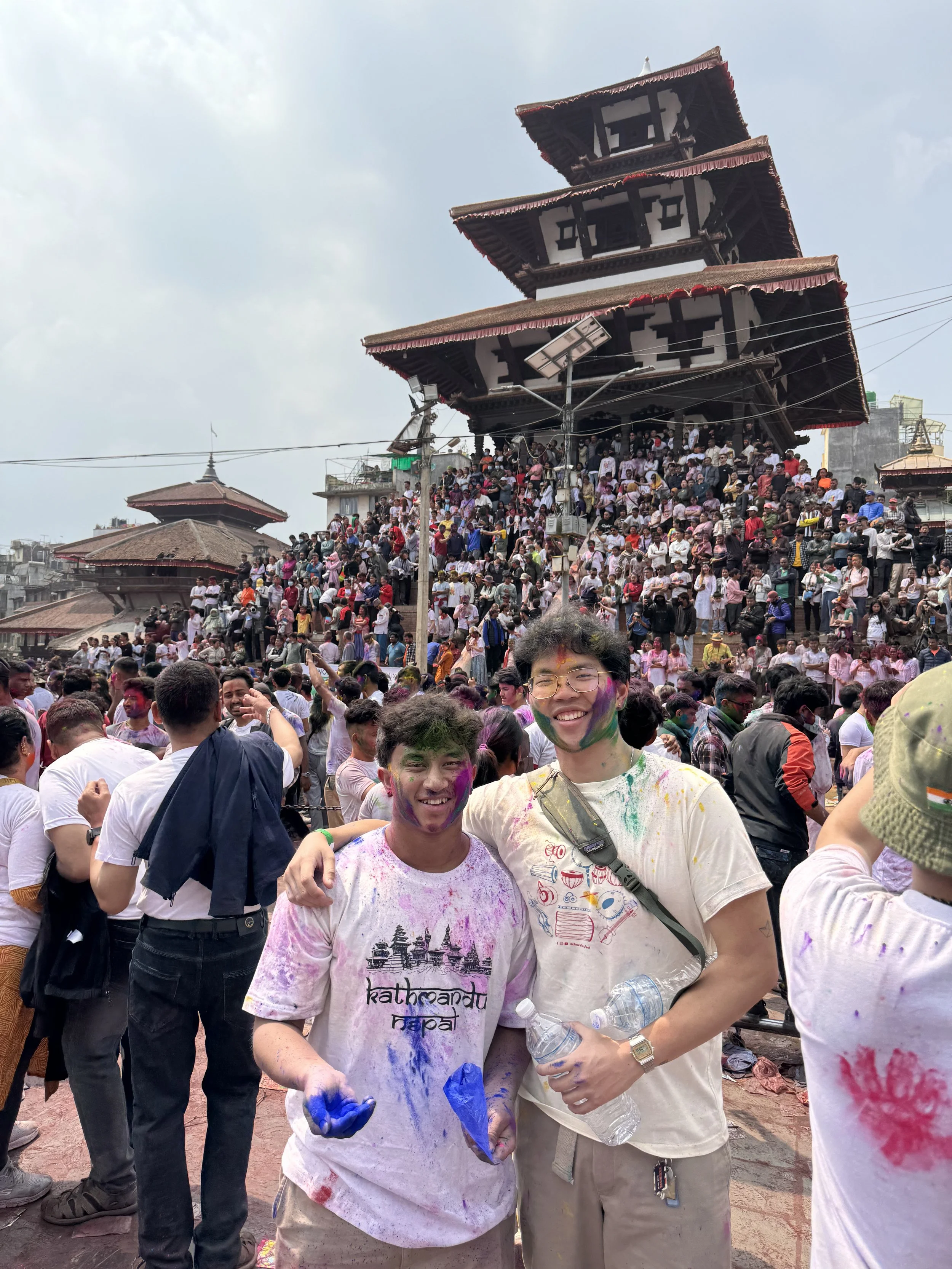
Leo celebrates Holi with his brother, Jet, in Kathmandu
What's a fun or meaningful Shansi memory that resonates with you?
Ahh, there are too many to count! The best part of my Shansi experience was hands down getting to travel with some of the most amazing people I've ever met. An abridged version of some memorable adventures: Watching my co-fellows Zack & Ris (J.F.O.) perform at a jam session in Tokyo and learning to ride scooters with Anokha (Keystone) in Madurai!
There is one specific Shansi memory that always makes me laugh—over Christmas break, Donnie (American College), Paris (UGM), Ari (SKU), Haley (SXU), Tiffany (SXU), Dina (SXU), and I embarked on an insane 3-week trip across Vietnam and Thailand. After nearly missing our flight to Phuket, we somehow made it to our hostel at 1 a.m. only to discover that the entire hostel staff was out celebrating New Year's Eve. With no clear way to check in, the group slumped in the lobby resigned to "Hunger-Games-It"—i.e., split who takes watch and who sleeps on the floor. Fortunately for us, Donnie was able to secure the last two beds at a nearby hotel and the group quickly snuggled up with 3-4 people to a bed (Charlie and the Chocolate Factory style). Maybe it was the travel-induced delirium, or just the relief of having a place to sleep, but I swear I have never laughed more than when Donnie, Tiffany, and I sardined ourselves into a queen bed and Tiffany exclaimed, "I'm in a MANwich!" before promptly falling asleep.
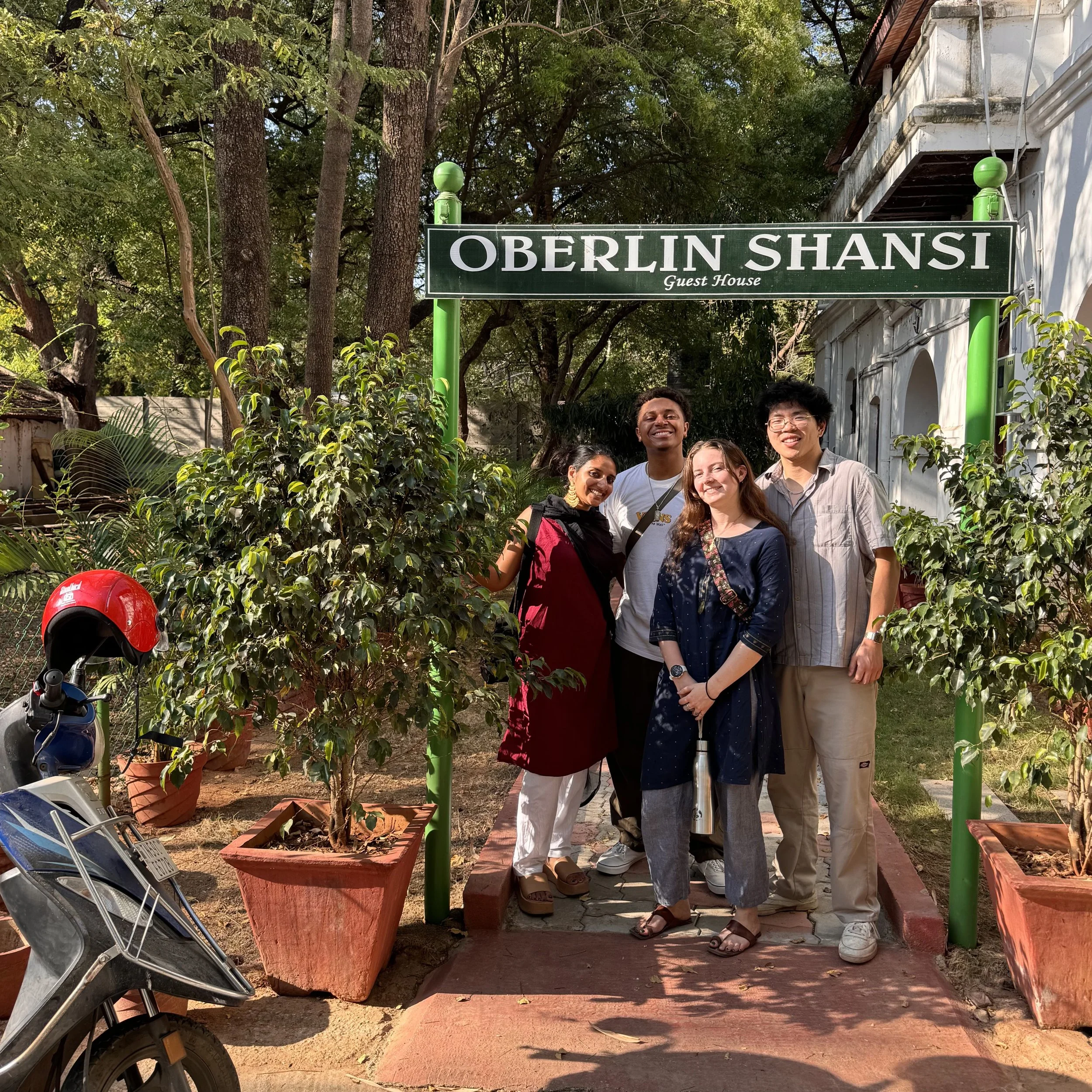
Leo with other Shansi Fellows; Anohka Venugopal, Donnie Harris, and Phoebe von Conta at The American College in Madurai
How has your time as a Shansi Fellow impacted your career trajectory so far?
My time as a Shansi Fellow completely influenced how I think about cultural exchange, belonging, and community. Navigating daily life in a language that I was still learning allowed me to understand what it feels like to be an outsider in an unfamiliar place. When I couldn't tell the difference between ingredients at grocery stores or struggled to navigate public transit, I relied heavily on the generosity and patience of others. These experiences have completely shaped my approach to policy. In my current work as a public servant, when I think about how to support constituents in NYC, I often draw on my own experience of relying on various support networks.
More personally, the Shansi Fellowship gave me a phenomenal community that has continued to push, motivate, and challenge me long after the end of my fellowship. When I was applying for the Marshall Scholarship, Shansi Fellows from all over the world helped me clarify my ideas, reviewed my drafts, and even hosted mock interviews. This unwavering support was invaluable because, as Shansi fellows themselves, I knew that they deeply understood the intricacies of living abroad. Knowing that I have a community of Shansi Fellows dedicated to cross-cultural exchange gives me the confidence I need to tackle the work I want to do as a Marshall Scholar and beyond!
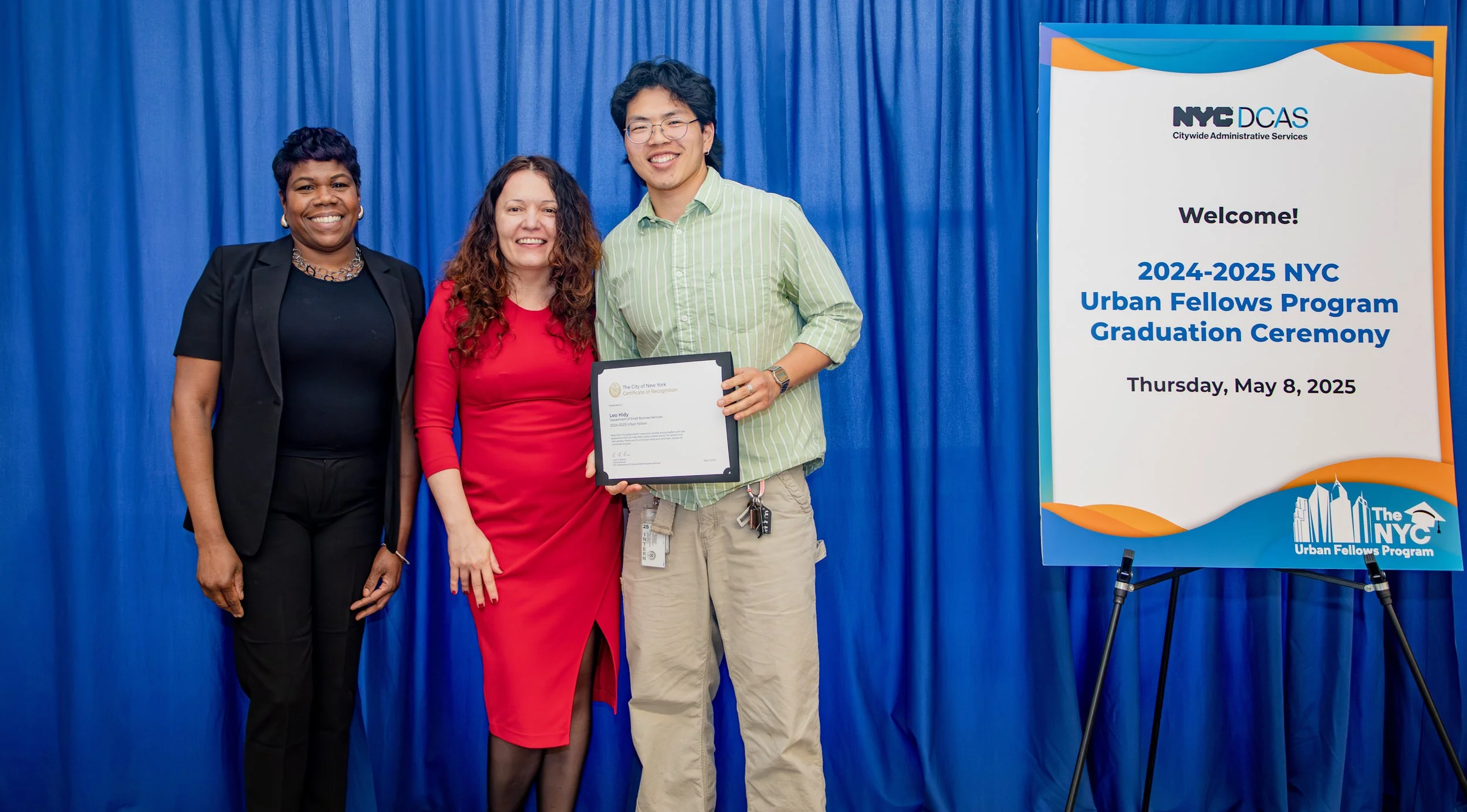
Leo graduates from the Urban Fellows Program